
 Since the late 1990s, all you've heard is how the Yankees are ruining baseball because of the way they utilize their bottomless wallet. They used their seemingly limitless resources to go after every free agent and either raised the price on the free agent or eventually signed the player. They were 'ruining the competitive balance' of the league. They were the reason why baseball needs a salary cap. While the Yankees are the prime example of this, there are other culprits. The Red Sox, Cubs, and Mets (among others) spend heavily and do so with no apologies for teams like the Tampa Bay Rays or Kansas City Royals.
It is now 2008. The Yankees still spend closer to 200 million than 100 million and they have 3 infielders making at least 19 million dollars annually. Is this good for baseball? Probably not but the Yankees have zero titles in the last 7 season so we can't say that spending equates to victories. But I propose another demon in the baseball world that will be the cause for the future failure of teams and a higher percentage of salary inflation than the Yankees were ever responsible for: The Colorado Rockies.
You heard me correctly. 'Rocktober' has turned into 'Rockonomics' as they have signed many of their young players to long term deals very early into their careers. Not all of these signings are as bad as others but we'll list a few:
- Brad Hawpe - 3+ years of service time - Signed $17 Million/3 Years Contract
- Manny Corpas - 1-2 years of service time - Signed $8 Million/4 Years Contract
- Aaron Cook - 4 years of service time - Signed $34.5 Million/4 Years Contract
- Troy Tulowitzki - 1+ year of service time - Signed $31 Million/6 Years Contract
Now, I can probably see the Hawpe and Cook signings as your typical buy-out of arbitration years. That is an exchange of a discounted price for security and it is a standard practice in Major League Baseball. The other two signings - Tulowitzki and Corpas - are the cause of the complaints of players like Cole Hamels, Prince Fielder, Jonathon Papelbon, and Nick Markakis and the reason why we cheer players like John Maine for 'being grateful' for being paid a couple hundred thousand dollars for playing a game.
The salary ladder in the MLB is somewhat complicated and can be frustrating to players, especially when they hear the league is making 6 billion dollars in a year. During the first years of a player's career, they are under 'team control' where they can be renewed at whatever price the organization sees fit. Entering their third year, a player is allowed to post a price he believes he deserves and the organization can decide whether or not to match that number. These are a players 'arbitration eligible years' since they have some say in their salary (if the team/player can't come to an agreement, an arbitrator will decide which number to go with). After these years, a player can become a free agent if he is not signed to a long term deal beforehand. Standard practice in baseball has been to keep players under team (and salary) control as long as possible and potentially strike a deal that will buy out the last few arbitration eligible seasons and a year or two of free agency.
 Those first three (potentially 2 if they enter the 'Super 2' Exception, which we won't go into) years of a players career are under the team's control. This isn't indentured servitude, it just means that the league is only required to pay you the league minimum. With young players, teams usually increase their pay from year to year if they are continuing to compete at the MLB level but they never approach the numbers that players can reach once they enter salary arbitration. These are the few years where an organization gets a true discount on a player's services since the salaries in the MLB have skyrocketed. It was sort of an accepted way of the game as it is in any other job in the world. You have to do your time. The millions will come if you are a special player, like Troy Tulowitzki, but you went through the system and eventually got your payday.
Is this a good financial decision for the Rockies? As I said earlier, absolutely. If the Rockies treated Tulowitzki the way the Yankees handled Derek Jeter, he would have taken them to the bank in salary arbitration and probably held them ransom during his free agency years (again barring injury). However, in the world of baseball, these decisions give other young players the idea that their teams are doing something wrong or disrespectful by not doing the same thing for them. This creates tension between sides and could eventually lead to situations where players leave teams not because of a team's lack of financial freedom to sign them but because the two sides have animosity towards one another.
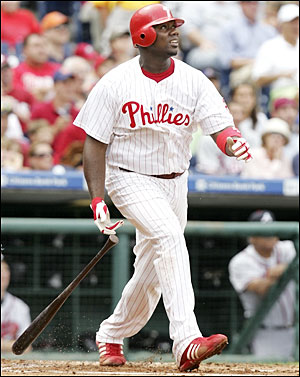
So when Cole Hamels leaves Philadelphia after years of arguing over his salary and signs with the big market team that would love a fire-balling left hander, is it the poisons of the overpriced free agent market, the lack of 'team loyalty' now a days, or this new precedent being set among teams (Cleveland with Sizemore is another example) where they are throwing their initial years of salary control out the window in exchange for a discount later? When Prince Fielder leaves, who do we blame then? While I don't agree with the idea that Jonathon Papelbon will settle for a $400,000 contract in protest of the Red Sox not giving him $900,000 or Hamels being upset at $500,000, I can see the logic to be honest. The system functioned. That wasn't the area that was ruined competitive balance. A player worked through his first few years and would be rewarded in salary arbitration or with a long term deal. Even the Yankees followed that model (see: SP Wang). The Yankees took Derek Jeter year to year and eventually paid for him. I am not suggesting that teams should go year to year and pay top dollar for their homegrown talent. Teams buying out arbitration years makes sense and that practice has helped smaller markets keep their players at a relative discount. But the idea that organizations would give so much so soon to players makes no sense from a financial standpoint.
There is a lot of money in baseball and if the game is making so much money I think the players should as well, but business is business. Teams should use those first three years to reward their young players in small increments and maybe build a relationship that can settle a deal for the arbitration years. Those three years are a way for a team to avoid Carl Pavano-itis. As a fan, I would want my team to audition a player for as long as possible as long as it made financial sense but kept a healthy relationship between the player and team before they signed him to 6 years. If organizations start to feel pressured to pay up sooner in order to avoid tempers flaring and scarring away talent, you might see more one year wonders turning into 8 year headaches than you see Rookie of the Years turning into MVPs (which Manny Corpas and Troy Tulowitzki were not...that would be Ryan Howard, and he is still going through arbitration).
The next time you complain about prices of the game and the salary of the players, save a few curse words for the Rockies while you rant about A-Rod and the Yankees. Remember, the Yankees can only 'steal' players with their evil money if they make it to free agency and if the model being utilized in Colorado isn't adapted by other teams, you can bet many young stars will grow very upset with their teams and look to leave as soon as possible and strike it rich in the free market. Or just ask yourself this...if you went out to dinner and the bill read $20, would you pay $60? If yes, I would love to be your waiter. If not, why should teams be expected to pay A-Rod money for players whose service time says they can make league minimum?
Disagree? Comment or call in this Sunday on Matt and Joe Radio.


No comments:
Post a Comment